4D Polytope Viewer
Interactive 4-dimensional geometry on the web, built to be understood.
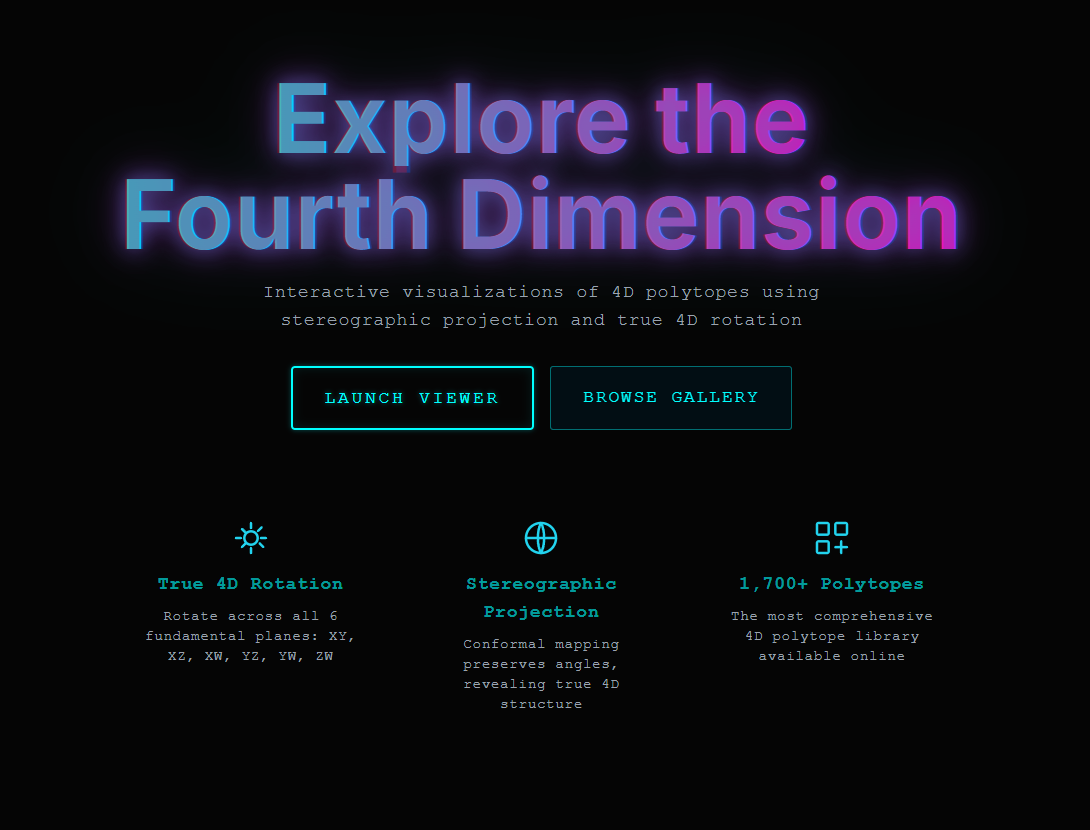
Most 4D visualization tools on the web are academic-feeling, unpolished, or both. I wanted a viewer anyone curious about 4D geometry could open and immediately get something from — math-curious users, educators, hobbyists searching "4D polytope," and people who landed on it for the aesthetic. It's part of my mathematical-art brand: math as visual culture, not as homework.
Three choices that mattered.
- 01
Cyberpunk/neon aesthetic as accessibility strategy.
The visual language — neon palette, glow, futuristic UI — does UX work. It signals "this is cool to play with" before the user reads a single word. For a topic with a high cognitive barrier, the aesthetic lowers the activation energy more than any tutorial overlay would.
- 02
Open core plus a small paid export tier.
The core viewer is open-sourced — anyone can read, run, or embed it. The version at 4d.pardesco.com adds export features for a small fee. Free for exploration and learning; paid for utility. The split lets the brand serve both communities without compromising either.
- 03
AI-accelerated build, human-debugged on the hard parts.
Claude Code and Gemini CLI handled scaffolding and iteration. The complex 4D rotation math and web-perf work were hands-on debugging that I had to drive directly. AI was a force multiplier on velocity; correctness on the hardest parts still needed human attention. An honest reading of what the tools can and can't yet do.
Claude Code and Gemini CLI across development. There is no AI inside the product itself — the case-study angle here is "AI as collaborator in building hard things." Three.js / React Three Fiber for rendering, custom rotation math for the 4D-to-3D projection, performance-tuned for the web.
Live at 4d.pardesco.com, indexed for 4D / polytope-related search queries. Open-source core publicly available on GitHub; private paid tier for users who need export. Demonstrated at a time when AI coding capabilities of this scope were noteworthy.